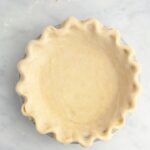
Homemade Pie Crust
Learn how to make your own homemade flaky pie crust! This all butter pie dough only uses four simple ingredients, and I have some tips on how to make your pie dough extra flaky. This is my go-to flaky pie crust that I use every Thanksgiving, or whenever I want to make a pie recipe!
Servings: 2 pie crusts
Calories: 1741kcal
Ingredients
- 3 cups all purpose flour
- 1 teaspoon kosher salt
- 2 tablespoons white sugar
- 2 ½ sticks unsalted butter cold
Instructions
- Fill a measuring jug with water and ice, place in the fridge. Take out 2 pieces of plastic wrap and place it near where you are working. Take your butter and slice into ¼ inch pieces.2 ½ sticks unsalted butter
- In a large bowl, whisk together the flour, salt and sugar.3 cups all purpose flour, 1 teaspoon kosher salt, 2 tablespoons white sugar
- Toss the cubes of butter in the dry ingredients, making sure they’re all evenly coated. Use your fingers to smoosh the butter into the flour, you want to completely flatten the cubes and make them smaller until the biggest pieces of butter are about the size of a walnut half.
- Drizzle 10 tablespoons of your ice water into the flour (make sure not to have any ice fall in). Use your hands to toss the flour and butter. Continue tossing the mixture until it forms a shaggy mass. Continue drizzling ice water, a tablespoon at a time, and kneading the dough until just a couple of dry spots remain and you have one large piece of dough.
- Divide the piece into 2 and form into 2 discs. Wrap them tightly in the plastic wrap. Refrigerate for 30 minutes.
- Take them out of the fridge and let it sit for about 5-10 minutes (depending how cold your kitchen is) to make it easier to roll out. One disc at a time, place it on a lightly floured surface and roll the dough out into a rectangle. Fold the dough in thirds, then rewrap tightly in plastic. Refrigerate for at least another 2 hours (or up to 2 days). This step is optional but gives you a flakier pie dough and I find it easier to work with.
- Take the dough out of the fridge and let it come to room temperature for 5-10 minutes. Roll the dough out on a lightly floured surface until it is about an inch or two wider than your pie plate. I find it easiest to gently lift the dough and place it on to the plate, but you can also roll it up on to your rolling pin and then unroll it on to your pie plate.
- Let the dough slump into the plate and press very firmly on to the bottom and the area where the side and the bottom of the pie plate meet – this is going to help it not slump when baking!
- Tuck the overhang underneath, this is going to give you a thicker edge. Crimp the edges as desired, crimping firmly into the pie plate is going to help it not shrink and hold its shape.
- Use a fork to prick the bottom a few times – this will make the bottom not puff up as much when baking.
To Parbake
- With an oven rack in the middle position, preheat your oven to 425°F/220°C.
- Line the inside of the pie dough with two pieces of foil, making an X shape, and be sure you have the foil hanging over the edges – this will make it easier to lift out after baking. You also want the overhanging foil to cover the crust so it doesn’t brown too much.
- Fill the pie plate with your pie weights, dried beans or sugar. Bake on the middle shelf of your oven for 15-20 minutes. Quickly take the pie out and lift the foil and pie weights out. Reduce the oven temperature to 350°Fahrenheit/175°Celsius and place the pie back in. Bake for another 10 minutes until light golden brown. Remove from the oven and let cool completely.
Video
Notes
This makes enough pie dough for a double crust pie or two single bottom crust pies. If you want to just make 1 pie crust, you can cut the ingredients in half.
Making Ahead: you can make the pie dough 2 days in advance, keep tightly wrapped in plastic wrap in the fridge. Leave on the counter for 5-10 minutes before rolling out.
Nutrition
Calories: 1741kcal | Carbohydrates: 155g | Protein: 21g | Fat: 116g | Saturated Fat: 73g | Polyunsaturated Fat: 5g | Monounsaturated Fat: 30g | Trans Fat: 5g | Cholesterol: 304mg | Sodium: 1182mg | Potassium: 235mg | Fiber: 5g | Sugar: 13g | Vitamin A: 3530IU | Calcium: 63mg | Iron: 9mg
